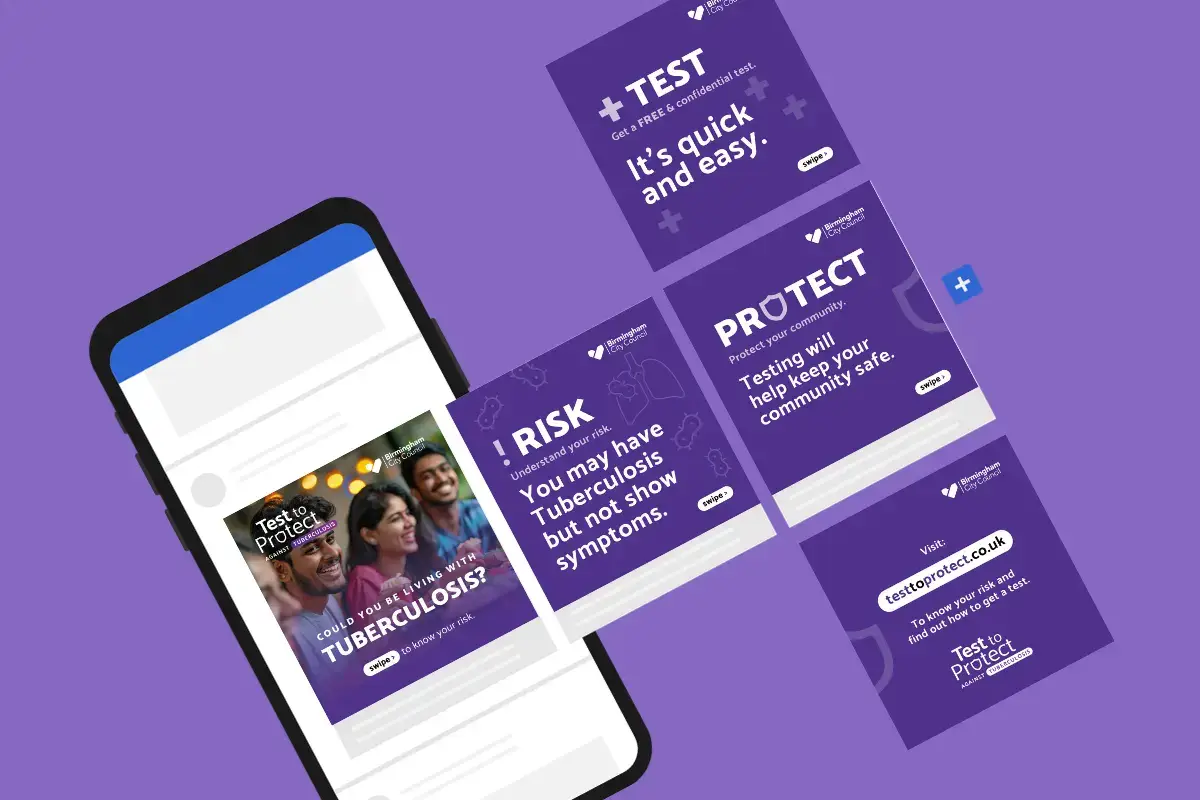
Birmingham City Council needed to reach communities most at risk of Hepatitis B, Hepatitis C and Tuberculosis – and move them from awareness to action.
The challenge wasn’t information. It was stigma, silence, and access.
We designed a public health behaviour change campaign that reframed testing not as something to fear – but something to protect.
The challenge
Reaching the people most likely to miss testing.
Many at-risk communities face overlapping barriers:
Language and health literacy gaps
Cultural stigma and fear of diagnosis
Conditions that often show no symptoms
Limited trust in traditional health messaging
To work, the campaign had to feel relevant, respectful, and easy to act on – across multiple communities, channels, and contexts.
The strategy
Design for real-world behaviour.
Using the COM-B model and Behaviour Change Wheel, we identified what was stopping people from testing – and what could move them forward.
The insight was clear: People are more motivated by protecting others than protecting themselves.
We built everything around this: Test to protect yourself. Test to protect your family.
The output
01.
A trusted, protective brand
Test to Protect is a public health behaviour change campaign that we designed to be a trusted, accessible public health identity – simple language, strong symbolism, and minimal cognitive load.
02.
Audience-specific campaigns
Our two tailored strands ensured relevance without dilution:
Hepatitis awareness for Asian and Asian British men aged 35–49
Tuberculosis awareness for non-UK-born Pakistani men aged 25–34
We used culturally informed visuals, colour psychology, and messaging that framed testing as a responsible, protective act.
03.
Multi-channel activation
Out-of-home, social, radio, door drops, and community partnerships – meeting people where they are, not where services expect them to be.
04.
Digital-first pathways.
The campaign website provides clear education, self-referral, and next steps – removing friction at the point of action.
The impact
11.4M+
OOH impressions across Birmingham.
113,000
People reached via FM radio.
60,000
Digital radio plays with a 98% listen completion rate.
70,000+
Adshel impressions in target areas.
6,400
Unique website visitors.
10%+
Onward engagement with additional resources.
Why it worked.
Because it respected context.
The campaign didn’t lecture. It didn’t alarm. It made testing feel normal, responsible, and achievable.