
Making safety personal, through the people around you.
Brand
Derventio Housing Trust
Campaign
Don’t Be The One
Fire Safety
One decision.
Shared consequences.
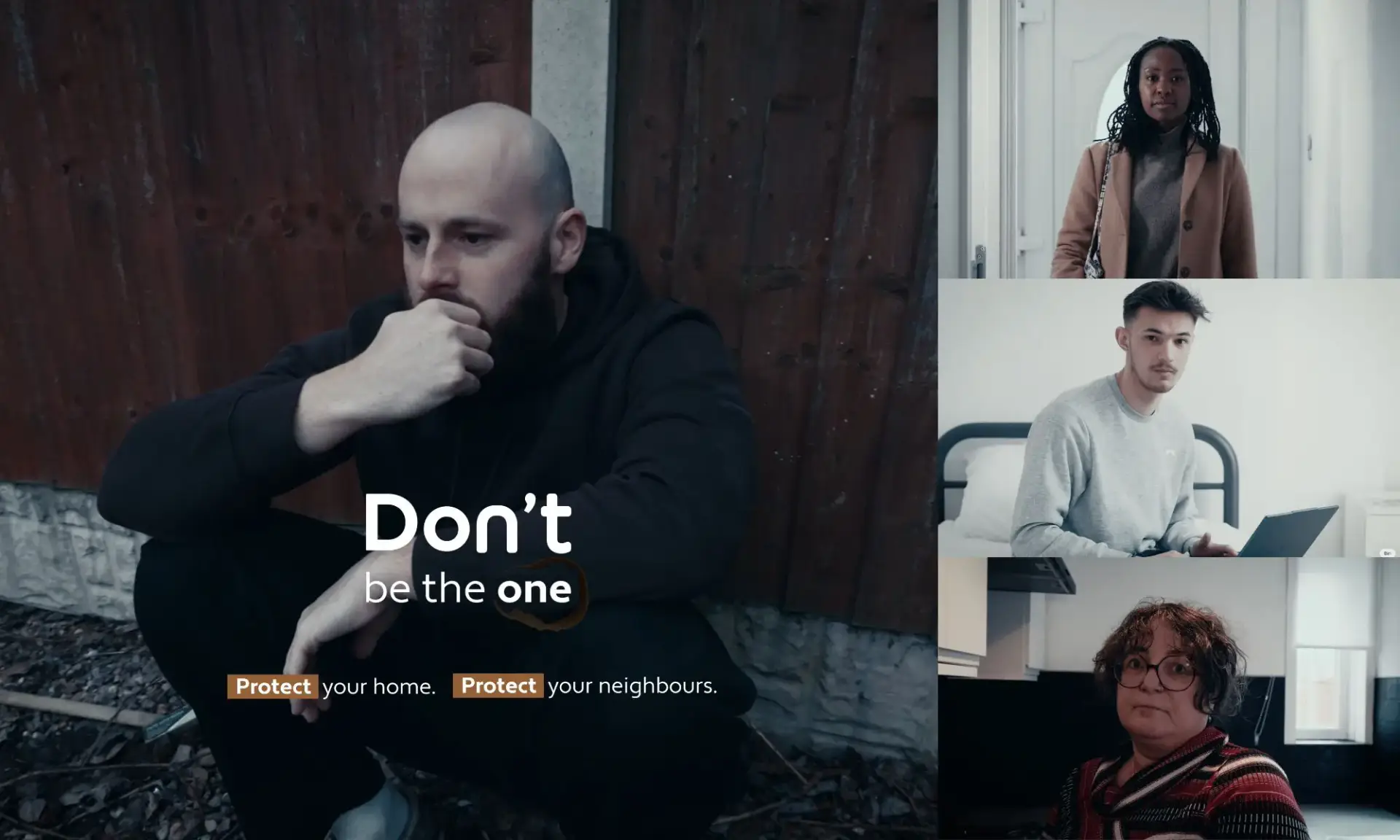
‘Don’t Be The One’ is a fire safety behaviour change campaign developed for Derventio Housing to address a growing risk: fires caused by e-scooters and e-bikes being stored and charged inside properties.
But this wasn’t just about communicating a rule. It was about shifting behaviour in an environment where authority alone doesn’t cut through – and where the real influence comes from the people around you.
- The challenge
Beyond awareness. Towards accountability.
E-scooters and e-bikes present a serious fire risk – particularly in supported housing, where shared living environments increase the potential for harm.
But the barrier wasn’t awareness alone.
Residents often:
- Underestimate the likelihood and severity of fire risk
- Prioritise convenience over safety
- Are less responsive to authority-led or policy-driven messaging
- Are influenced more by peer norms than formal rules
Crucially, this meant that traditional safety communications, focused on rules, instructions, or consequences in isolation, were unlikely to shift behaviour.
This created a critical challenge: how do you drive behaviour change in a context where traditional, top-down communication is likely to be ignored?
The campaign needed to:
- Cut through quickly and hold attention
- Make the risk feel immediate and real
- Shift social norms – not just individual knowledge
- Create a sense of responsibility to others, not just compliance
Because in shared housing, the consequence is never individual.
- The strategy
Peer-led. Emotionally real. Behaviourally grounded.
01.
Feedback on outcomes of behaviour
02.
Information about social and environmental consequences
03.
Anticipated regret
04.
Information about others’ approval
Inspired by behavioural evidence on emotional storytelling and social norms, we designed the campaign to reframe the decision:
Not “follow the rule”
But “don’t be the person who harms the people around you.”
This led to a concept built around a simple, powerful line: Don’t Be The One.
Delivered through:
- Peer perspective storytelling – residents speaking directly to camera, creating emotional proximity and accountability as they describe what they stand to lose
- Everyday relatability – showing ordinary moments across a shared home to reinforce “this could be us”
- Consequence-led narrative – building from normality to devastating outcome
- Clear, minimal language – designed for accessibility and low cognitive load
- The output
01.
Behavioural intervention design
A behaviour-led campaign concept
A short-form video asset
Peer-centred storytelling
05.
Supporting print for reinforcement
06.
End-to-end delivery

- The impact
From individual choice to collective responsibility.
The campaign shifted the conversation from rule enforcement to shared accountability.
- Increased understanding of fire risk in a way that feels real and immediate
- Stronger emotional connection to the consequences of unsafe behaviour
- Greater recognition of how individual actions affect others
- Improved likelihood of compliance through peer-driven motivation
By placing fellow residents at the centre of the story, the message lands where it matters most – not as instruction, but as responsibility.
“We were thrilled that MacMartin agreed to work with us on our e-scooter campaign. We asked them because of their expertise in behaviour change; we wanted something that would work better than staff just saying, ‘No, you can’t do that’. Laura and the team were brilliant throughout, great communication, very clear and timely.”

What we did.
Behavioural research & intervention design
- COM-B analysis & insight development
- Campaign concept development
- Video scriptwriting & storyboarding
- Video production & editing
- Supporting print design (leaflet)
- Campaign testing & refinement
Why it worked.
Because it aligned with how behaviour actually changes.
In this context, behaviour isn’t driven by authority. It’s shaped by:
- Social norms
- Emotional relevance
- Perceived impact on others
This campaign brought all three together.