
Helping carers start conversations that matter.
Brand
Campaign
Because We Care
Smoking Cessation
Small conversations. Meaningful change.

Small conversations. Meaningful change.
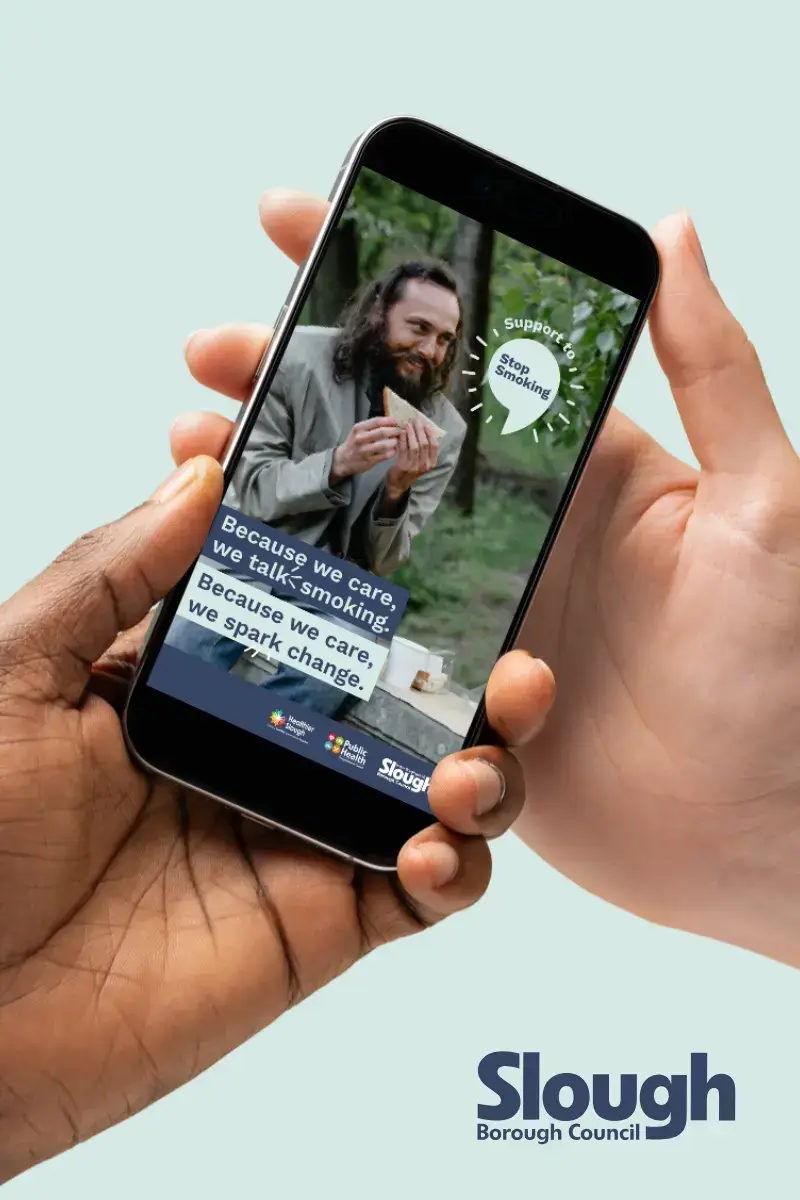
‘Because We Care’ is a smoking cessation behaviour change campaign developed with Slough Borough Council to increase referrals to local smoking cessation services among individuals with serious mental illness, learning disabilities, autism, and people experiencing homelessness in Slough.
Through behavioural research, we identified a critical structural challenge: the existing system was not designed for easy access. Pathways into support were complex, fragmented, and difficult to navigate – particularly for those already facing multiple barriers.
With limited ability to redesign the system itself, we needed to rethink the role of the campaign.
We designed a campaign that targets those closest to vulnerable individuals and equips them with the tools, confidence, and language to take the first step – a conversation.
- The challenge
Reaching people through trusted voices.
Smoking rates remain significantly higher among individuals facing complex challenges – including serious mental illness, learning disabilities, autism, and homelessness.
But traditional campaigns often miss the mark.
The issue was access. Existing referral pathways placed too much friction on individuals already navigating complex circumstances.
The real opportunity sat elsewhere:
with the people already supporting them.
The challenge was to:
- Reach and engage underserved groups, making it easier to access support
- Reduce stigma around quitting smoking
- Make support pathways clear and accessible
- Translate intention into action – a conversation, a call, a referral
The priority was for this campaign to feel and sound supportive, not preachy.
- The strategy
Behavioural insight. Human connection. Practical tools.
We grounded the campaign in behavioural science – focusing on removing barriers and increasing confidence at the point of action.
Through research, stakeholder engagement, and behavioural analysis, we identified key friction points:
Crucially, we recognised that expecting individuals to navigate the system themselves was unrealistic.
Instead, we adopted an indirect, bystander-style approach – shifting the focus from the individual to the people around them.
We developed a smoking cessation behaviour change campaign centred on:
- Empowering carers and outreach workers to start sensitive conversations
- Prompting conversations, not prescribing outcomes
- Equipping carers with practical tools and language
- Making the next action (a phone call) immediate and achievable
- Using trusted relationships as the catalyst for change
The campaign message, Because We Care, reinforces motivation rooted in empathy and not instruction.
- The output
01.
Behavioural insight & intervention design
A clear, human campaign identity
Conversation prompt tools
Targeted print & digital assets
05.
Downloadable guides
06.
A dedicated campaign landing page
Stakeholder activation content
- The impact
Turning care into action.
The campaign repositioned smoking cessation as a conversation led by care, not correctio, empowering carers to start supportive dialogue and connect individuals to the right support.
- Increased awareness of local stop smoking support
- Greater confidence among carers in initiating conversations
- Clearer pathways to referral through simple, shared actions
- Strong engagement across stakeholder networks
By working with, rather than against, the realities of the system, the campaign enabled action where it was previously unlikely to happen.
By focusing on the moment that matters, the conversation, the campaign created the conditions for lasting change.
What we did.
- Behavioural research & insight development
- Stakeholder engagement & co-creation
- Campaign strategy & messaging
- Campaign branding & identity
- Print & digital asset design
- Web page design & content
- Campaign rollout & evaluation
Why it worked.
Because it understood where the change would really happen – with the people.
By focusing on trusted relationships, reducing friction at the point of action, providing simple, practical tools and grounding everything in empathy and realism – the campaign moved beyond awareness – and into action.
Clear prompts.
Accessible tools.
A message rooted in care.